

C_TFG51 Exam Questions & Answers
| Field | Exam Details |
|---|---|
| Exam Code: | C_TFG51 |
| Exam Name: | SAP Certified - Administrator - SAP Fieldglass Contingent Workforce Management (C_TFG51_2601) |
| Vendor: | SAP |
| Assessment Type: | SCENARIO BASED Assessment |
| Total Questions: | 416 Question Answers |
| Passing Score: | 60% |
| Duration: | 120 Minutes |
| Last Updated: | Oct 08, 2026 |

Visual Learning. Real Results.

Get Certified with Cert4Prep. Your Trusted Partner for Exam Success
- 100% Authentic & Verified Exam Materials
- Guaranteed Success in Your Certification Exams
- Instant Access to the Latest Study Resources
- Access Your Exams Anytime, 24/7
Pass SAP C_TFG51 on Your First Attempt with Cert4Prep
Cert4Prep provides you with the comprehensive study material that allows you to prepare confidently for your SAP Certified – Administrator – SAP Fieldglass Contingent Workforce Management (C_TFG51_2601). Our practice test and PDF files are designed by the field experts for you.
What is Included in Cert4Prep Exam Materials?
- Web-Based Practice Test Software: SAP Certified – Administrator – SAP Fieldglass Contingent Workforce Management (C_TFG51_2601) practice test that can be accessed online, only with an internet connection, and simulates the real exam experience.
- Windows-Based Practice Test Software: Downloadable C_TFG51 practice test software that simulates the real exam without an internet connection, making it flexible for you to study anytime, anywhere.
- C_TFG51 PDF: Printable, easy-to-read PDF file contains expert-verified questions to make your preparation on the go.
Why Choose Cert4Prep?
The features that make Cert4Prep stand out in this competitive market are as follows:
- 30-Day Money Back Guarantee: We are 100% sure that our product will pass your exam on the first go or get 100% refund within 30 days of the purchase
- 90-Day Free Updates: As the exam syllabus changes over time, we ensure you are always aligned with the latest syllabus. Our experts instantly update the syllabus as the SAP updates it.
- 24/7 Live Support: We are always here for your assistance. We provide 24/7 live support to answer all your queries related to our product
- Real Exam Simulation: Our practice test simulates the real SAP Certified – Administrator – SAP Fieldglass Contingent Workforce Management (C_TFG51_2601) experience, making you confident for the exam day
- Performance Tracking: Our performance-tracking feature lets you monitor your progress so you can focus on your weak areas and prepare well for the Exam.
- Instant Access: Access your study material immediately after purchase, with no waiting.
- Free Demo: We provide a free Demo of our PDF files, so that first you will be aware of the quality of our product, then make a purchase
Start your SAP Certified – Administrator – SAP Fieldglass Contingent Workforce Management (C_TFG51_2601) preparation journey now with Cert4Prep’s exclusive C_TFG51 Study material and avail 15% exclusive discount using code LEARN15
| 100% C_TFG51 Verified Questions | Our content is regularly verified by certified professionals, ensuring that you study only the most authentic and up-to-date exam questions. |
| 90 Days of Free Updates | Stay ahead of exam changes with free updates for 90 days Guaranteed that your study materials remain current and accurate. |
| Web & Mobile Access | Study on your own terms. Our platform allows seamless access across all devices desktop, tablet, or mobile anytime, anywhere. |
| 100% Guaranteed Success | Prepare without stress. Our Pass Guarantee means you can study confidently, knowing that your success is our commitment. |
| 24/7 Customer Support Live Chat | Whenever you need assistance, our expert support team is available around the clock to guide you. |
| Realistic Exam Environment | Simulate real exam conditions with our practice tests designed to reflect the actual testing environment for maximum readiness. |
| Complete Course Coverage | Access detailed explanations, verified Q&A sets, and topic-wise coverage to strengthen your understanding. |
| Easy-to-Use Interface | Enjoy a smooth, interactive learning experience built for efficiency, comfort, and convenience. |
| Instant Access | Access product instantly for 90% of products after purchase and start preparing immediately no waiting time. |
1 Comment
Add a review
C_TFG51 SAP Certified – Administrator – SAP Fieldglass Contingent Workforce Management (C_TFG51_2601)
C_TFG51 Exam Overview
SAP Fieldglass Contingent Workforce Management sits in the part of the SAP portfolio that deals with external labour, statement of work oversight, and operational control over non-payroll spend. The C_TFG51 certification targets administrators who need to understand how the platform is set up, governed, and used in day-to-day business operations. It is a technical administration certification in a business application context, which means the exam is less about abstract theory and more about how the system behaves when organisations manage workers, suppliers, approvals, and compliance rules through SAP Fieldglass.
This certification is relevant for people who support implementation teams, manage tenant configuration, or handle ongoing administration after go-live. It also maps well to roles that sit between procurement, HR, and vendor management, because contingent labour is rarely owned by just one department. The exam evaluates whether a candidate can work inside the SAP Fieldglass operating model with enough precision to keep processes consistent, auditable, and aligned with how an enterprise actually buys external talent.
If you are also building a wider SAP career path, the SAP certification category on Cert4Prep is the natural starting point for related preparation paths.
What SAP Fieldglass Administration Really Covers
SAP Fieldglass is built for controlling external workforce and services spend across a business network, not for generic time tracking in isolation. In practice, administration touches worker records, job postings, work orders, approvals, rates, supplier relationships, and compliance controls. A candidate needs to understand how those objects behave together, because the platform only works properly when configuration, process, and integrations line up.
The administrator’s job is to keep the tenant usable for the business while preserving governance. That means knowing where master data enters the system, how transactions flow, what users see, and which settings influence downstream behaviour. The exam rewards people who understand the operational consequences of configuration, such as why a poorly designed approval chain creates bottlenecks, or how an inaccurate rate card model distorts both cost control and reporting.
The Business Model Behind Contingent Labour
External workforce management is not just a software category, it is a governance problem. Organisations use SAP Fieldglass because contingent labour comes with different controls than payroll employment. There are supplier commitments, rate agreements, statement of work engagements, approval hierarchies, onboarding checks, and sometimes country-specific compliance obligations. The platform provides a structured way to capture those moving parts.
A strong candidate understands the distinction between an individual worker engagement and a services engagement. Those are not interchangeable operationally. Contingent workers usually require identity, assignment, timesheet, and cost-centre handling. Services procurement often starts with a scope of work and relies more heavily on milestones, deliverables, and contract governance. Many implementation errors happen when teams try to force both models into one process design without respecting the different approval and control requirements.
How the Fieldglass Ecosystem Fits Together
SAP Fieldglass does not sit alone. It usually connects to enterprise systems for identity, finance, procurement, and downstream reporting. In a real deployment, administrator decisions affect how data moves between the SAP Fieldglass tenant and systems such as SAP ERP, SAP S/4HANA, or corporate single sign-on services. That is why tenant administration has to be understood as part of an ecosystem, not as a set of isolated menus.
The practical sequence often begins with user access and role design, then moves into company structure, templates, suppliers, work order controls, and approval rules. Once transactions start flowing, integrations carry data into finance or analytics layers. If any upstream object is configured badly, the problem surfaces later as a failed approval, a mismatch in billing, or a reporting gap that is tedious to unwind. The best administrators think in terms of dependencies, not screens.
Configuration Choices That Matter in Day-to-Day Operation
Administrative work in SAP Fieldglass is often defined by small configuration choices that have large operational consequences. Template design is one of the most important. Templates determine what users can create, which fields are required, and how much structure the business imposes on a request or assignment. Too much rigidity slows adoption. Too little structure produces unusable data.
Approval routing deserves the same attention. Approval chains are not merely procedural, they are a control mechanism. A good design reflects cost authority, supplier oversight, and location or department rules without creating a maze that users cannot navigate. Rate management, default values, and field visibility also matter because they shape both user behaviour and the reliability of reporting data. Administrators who treat these as cosmetic settings usually end up troubleshooting avoidable process failures later.
Integration Points and Data Flows You Need to Understand
A live SAP Fieldglass landscape depends on clean handoffs. User provisioning may come from identity management. Worker and supplier information may be mastered elsewhere. Financial and time data often need to reach back-end systems for invoice matching, accruals, or cost allocation. The administrator is not usually building every interface, but the administrator must understand the consequences when integrations are incomplete or out of sequence.
This is where many candidates underestimate the platform. The exam is not asking for a developer’s view of APIs, but it does expect familiarity with how data consistency is preserved across systems. A common operational issue is when reference data, such as cost centres, locations, or company codes, is not synchronised before transactional data is loaded. Once that happens, administrators spend time fixing root causes that were really data governance problems.
For product context, the official SAP Fieldglass product information is the most useful starting point for understanding the platform’s place in SAP’s external workforce portfolio.
Security, Roles, and Governance in a Fieldglass Tenant
Security in SAP Fieldglass is mostly about controlled access and process integrity. The administrator has to know how roles limit what a user can see and do, and why that matters in a multi-stakeholder environment. Buyers, managers, suppliers, and approvers do not need the same visibility. If access is too broad, confidential rate and assignment data leaks into the wrong hands. If access is too narrow, approvals and fulfilment stall.
Governance is broader than role assignment. It includes auditability, standard process enforcement, and the ability to show that contingent labour is being handled consistently. Enterprises depend on this discipline because external workforce spend is often large, decentralised, and exposed to regulatory and commercial risk. SAP Fieldglass is valuable when it helps organisations make those controls routine rather than exceptional.
Operating the Platform Without Creating Process Drift
Once the system is live, administration becomes a discipline of keeping standards intact. A well-run tenant does not slowly drift into one-off exceptions for every department. That kind of drift is common when users bypass templates, duplicate supplier records, or create informal approval shortcuts because the formal process feels inconvenient. Administrators need to recognise those behaviours early and correct them before the configuration becomes inconsistent.
Monitoring usually starts with failed transactions, incomplete approvals, and data quality issues. The best administrators look at recurring failure patterns rather than individual tickets. If the same kind of request keeps failing at the same stage, the problem is almost always configuration, master data, or integration design. Good operational support means identifying whether the failure belongs to the user, the template, the workflow, or a downstream system.
What Strong Candidates Actually Understand
Working Knowledge of Contingent Workforce Objects
A candidate should know how the main SAP Fieldglass objects connect in practical use. Job postings, worker records, assignments, timesheets, invoices, suppliers, and work orders each serve a different purpose. Confusing those objects is one of the fastest ways to lose marks, because the system is built around distinct business steps rather than a single generic labour record.
The real test is whether you understand the business reason behind each object. A worker is not the same as a supplier. An assignment is not the same as a timesheet. A work order is not the same as a service invoice. Those distinctions are what keep procurement, operations, and finance aligned.
Approval Logic and Control Design
Approval logic is one of the most exam-relevant ideas because it sits at the centre of governance. Candidates should know why approval routing exists, what triggers it, and how it protects the enterprise from uncontrolled spend. In practice, approval design has to consider hierarchy, thresholds, location, and sometimes contract type. If the design is too simplistic, it will not match how the business delegates authority.
People often miss that approval failures are not just system errors. They are often evidence that the business model and the configuration do not match. The better administrator learns to read the process rather than only the error message.
Supplier and Hiring Manager Collaboration
Fieldglass works because suppliers and internal stakeholders share a controlled process. Suppliers are not passive data sources, they participate in fulfilment, updates, and compliance steps. Hiring managers need visibility into candidates and assignments, while procurement needs control over rate and supplier usage. The platform is built to balance those needs, and the exam expects you to understand that balance.
Common Mistakes That Hurt Real Implementations
The first mistake is treating SAP Fieldglass like a simple forms system. It is a governed workflow platform, so the configuration must reflect business policy. When teams ignore that, they build a system that looks functional but fails under real operational load.
The second mistake is underestimating master data quality. External workforce processes depend on reference data that is clean, current, and aligned with the organisation’s finance and procurement structures. Bad location data, outdated cost objects, or duplicate suppliers create downstream cleanup work that is far more expensive than fixing the data model at the start.
The third mistake is over-customising the process before standard workflows are understood. The strongest default is to use SAP Fieldglass standard capabilities as far as they can reasonably go, then customise only where the business truly needs a differentiated control.
Where Candidates Lose Points on This Exam
Many candidates lose points because they remember terminology but not sequence. SAP Fieldglass questions often test the order in which objects or approvals make sense operationally. If you know the names of the parts but not how a requisition turns into a placement, a timesheet, or an invoice event, you will struggle with scenario questions.
Another common failure is confusing configuration intent with end-user behaviour. Administrators need to know what a setting does in the tenant, not just what it sounds like in theory. Examiners tend to probe exactly those places where a technically correct answer becomes wrong because it ignores process context.
The final trap is shallow familiarity with integration and governance. Even when the question is not about interfaces directly, it often assumes you understand how SAP Fieldglass fits into a larger enterprise control environment.
Preparing Through the Official SAP Learning Path
The best preparation for C_TFG51 is hands-on familiarity with SAP Fieldglass concepts, tenant behaviour, and business process flow. Read the official SAP learning material first, then reinforce it by tracing how a request moves through configuration, approval, fulfilment, and downstream processing. That sequence is more useful than memorising menu labels in isolation.
Use the official product and learning materials to build a mental model of the platform. Then practise explaining the same process from three viewpoints: the hiring manager, the supplier, and the administrator. That exercise exposes weak understanding very quickly, because each role sees the same transaction differently. If you can explain why a field exists, who depends on it, and what happens when it is wrong, you are preparing properly.
SAP Fieldglass in the Wider External Workforce Landscape
External workforce management has become a standard part of enterprise operating models because organisations rely on a mix of employees, contractors, consultants, and services providers. According to published labour-market and workforce management research, demand for skills in contingent labour governance and vendor management has remained steady because companies need tighter visibility over non-payroll spend, not less. That is the real context behind the certification.
SAP Fieldglass fits in the vendor management system space, but it is not just a procurement tool and not just an HR tool. It sits where workforce, sourcing, and finance meet. That is why people who understand the platform well tend to be useful in transformation projects, operating model redesign, and post-go-live support. The certification has value when it reflects that broader operational literacy, not just product familiarity.
Good Habits That Separate Competent Administrators from Casual Users
Keep the process standard until business rules prove otherwise
Experienced administrators resist the urge to create special cases too early. They start with the standard workflow, observe where the business genuinely needs a different control, then adjust the configuration with a clear reason. That approach keeps the tenant understandable and supportable.
Treat data quality as part of configuration
A clean process can still fail if the supporting data is bad. Cost objects, supplier records, role mappings, and location structures all need regular attention. Good administrators understand that governance is not separate from configuration. It is built into it.
Learn to read failures as process signals
When a request fails, look past the error text. Ask which dependency broke first. That habit turns support from guesswork into diagnosis. It also makes exam scenarios much easier to solve because you stop chasing symptoms and start identifying the point of control that really matters.
Related Certifications and Progression Path
For candidates who want to stay in the SAP external workforce and procurement space, SAP Ariba certifications can be a sensible adjacent path, especially where sourcing, supplier management, and procurement processes overlap with contingent labour governance. SAP SuccessFactors certifications become relevant when the organisation wants closer alignment between employee and external workforce processes, particularly around identity, workforce planning, and lifecycle management. Broader SAP administration or integration certifications can also help if your role touches multiple cloud products and back-end systems.
C_TFG51, SAP Ariba certifications, SAP SuccessFactors certifications, SAP integration-focused certifications
Frequently Researched Questions
1. What is SAP C_TFG51 about?
It is an administrator certification for SAP Fieldglass Contingent Workforce Management. The exam focuses on the operational and configuration knowledge needed to support external workforce processes, including controls, approvals, and system behaviour in a business environment.
2. Who should take the C_TFG51 exam?
It suits SAP Fieldglass administrators, implementation consultants, support analysts, and professionals who manage contingent labour processes in a controlled enterprise setting. It also fits people moving from procurement or vendor management into a more system-oriented role.
3. Is SAP Fieldglass more relevant to HR or procurement?
It sits between both, but in practice it often involves procurement governance as much as workforce operations. The platform is used to control external labour spend, manage suppliers, and enforce process discipline across departments.
4. Do I need hands-on SAP Fieldglass experience before taking this exam?
Hands-on experience helps a great deal because the exam is process-driven. Even if you have not administered a live tenant, you should understand how requests, approvals, worker records, and downstream processes connect in real use.
5. How technical is the C_TFG51 certification?
It is technical in the sense of platform administration, but it is not a development exam. You need to understand configuration, workflow logic, data flow, and governance rather than coding or low-level system administration.
6. What are the most important topics to study first?
Start with the SAP Fieldglass object model, approval flow, role design, and the distinction between contingent workforce and services procurement. Those concepts support almost everything else in the platform.
7. Does the exam focus on integration?
Integration is part of the wider administration picture because SAP Fieldglass commonly connects to identity, finance, and enterprise systems. You do not need to be an integration developer, but you do need to understand why interfaces and reference data matter.
8. What type of mistakes do candidates usually make?
They often learn terms without understanding the process sequence. Another common mistake is confusing business roles or mixing up what different objects are for. Scenario questions tend to expose that quickly.
9. Is SAP Fieldglass still relevant in modern enterprise architecture?
Yes. External workforce control remains a live enterprise problem because organisations continue to depend on contractors, consultants, and service providers. The need for visibility, compliance, and process control keeps the platform relevant.
10. How should I study for C_TFG51 without relying on memorisation?
Work through the end-to-end process mentally or in a training environment, then explain each step as if you were supporting a hiring manager or supplier. That method builds real understanding and is much more durable than memorising isolated facts.
11. What is the best next certification after C_TFG51?
That depends on your career direction. If you want to stay close to procurement and supplier governance, SAP Ariba is a natural next step. If you want to broaden into workforce and HR processes, SAP SuccessFactors is the better fit.
12. Is C_TFG51 useful for implementation consultants?
Yes, especially for consultants who configure tenants, support rollout decisions, or handle post-go-live issues. The certification validates that you understand the platform as an operating system for contingent labour, not just as a collection of screens.
13. What kind of work does a certified administrator typically handle?
A certified administrator usually supports user access, template and workflow upkeep, data quality, approval logic, and issue diagnosis. In mature environments, that role also participates in governance discussions and change control.
14. Why does SAP Fieldglass need so much governance?
Contingent labour is costly, distributed, and often managed across several business functions. Without governance, the organisation loses control over spend, compliance, and process consistency. SAP Fieldglass exists to make that governance operational instead of manual.
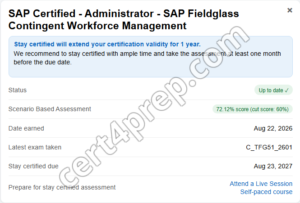
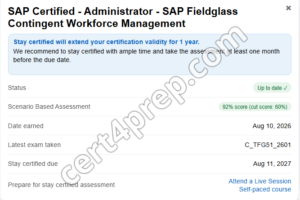
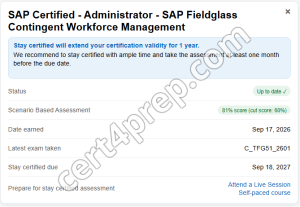
Camylle Prohaska
The review content worked best over the weekend